
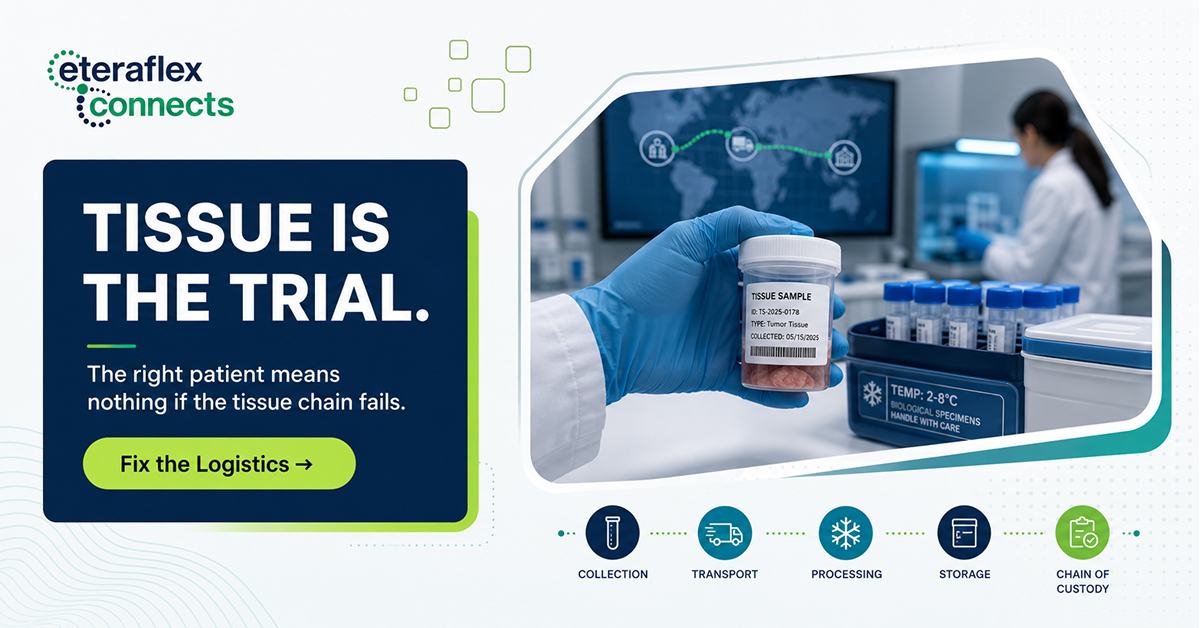
In a biomarker-gated oncology trial, the right patient existing is not enough — their tumor tissue has to be retrieved, shipped under controlled conditions, and confirmed by a central lab before they can enroll. Every handoff in that chain is a place an eligible patient silently drops out. Biomarker-gated studies fail on logistics far more often than on biology, and “patient volume” on paper turns into failed screens in practice when the tissue chain is not designed deliberately.
There is a quiet failure mode in precision oncology that rarely makes it into a protocol synopsis: the eligible patient who never enrolls because their tissue never arrived in usable form. It is not a science problem. It is a logistics problem wearing a science costume.
The chain that has to hold
A biomarker-gated trial conditions enrollment on a molecular result. To get that result, archival or fresh tumor tissue must be located, retrieved from the originating institution, packaged and shipped under controlled conditions, received intact, and confirmed by a central laboratory — all before the patient can be randomised. That is a chain with many links, and a chain is only as strong as its weakest one.
Slow retrieval, degraded slides, a broken cold chain, a lapse in chain-of-custody — any of these turns a genuinely eligible patient into a failed screen. The patient was real. The tumor was positive. The trial still lost them, to logistics.
Why volume alone doesn’t save you
It is tempting to believe that starting with more patients solves enrollment. It helps, but only if the funnel below it works. If the tissue chain leaks, more patients at the top simply means more failed screens at the bottom — the same conversion problem at larger scale. Volume is the start of the answer; orchestration is the finish.
This is the part of “patient access” that gets overlooked. Access is not just having patients in the catchment. It is the operational system that turns an eligible patient into a confirmed, enrolled one — and tissue logistics is the heart of that system.
Designing the chain, not improvising it
The fix is to treat retrieval, cold-chain handling, chain-of-custody, and central-lab confirmation as one designed system, planned and owned by a single team rather than stitched across vendors. Turnaround is engineered, not hoped for. Re-test logic is defined in advance. And every step is documented to the standard a U.S., EU, or Japanese sponsor expects in an inspection — because the volume only counts if the data behind it survives scrutiny.
Respecting the sponsor’s science
There is an important boundary here. Where a proprietary assay or interpretation belongs to the sponsor or a diagnostic partner, the right operational model orchestrates the sample-to-lab logistics and never touches the protected analysis. The job is to move the tissue intact and on time; the science stays the sponsor’s.
The reframe
When a biomarker-gated trial under-enrolls, the instinct is to question the eligibility criteria or the site selection. Often the real culprit is the tissue chain — and it is the most fixable of the three. Get the logistics right and the eligible patients you already have start converting into enrolled ones.
Frequently asked questions
Q: Why do biomarker-gated oncology trials fail to enroll? A: Frequently because the tissue needed to confirm eligibility does not arrive in usable form — slow retrieval, degraded samples, or broken chain-of-custody turn eligible patients into failed screens.
Q: How do you fix tissue logistics in a trial? A: Treat retrieval, cold-chain, chain-of-custody, and central-lab confirmation as one owned, designed system with engineered turnaround and inspection-grade documentation — not a series of vendor handoffs.
Q: Who owns the biomarker analysis — the CRO or the sponsor? A: Where the assay or interpretation is proprietary to the sponsor or diagnostic partner, it stays theirs. The operational team orchestrates sample-to-lab logistics without touching the protected analysis.

